
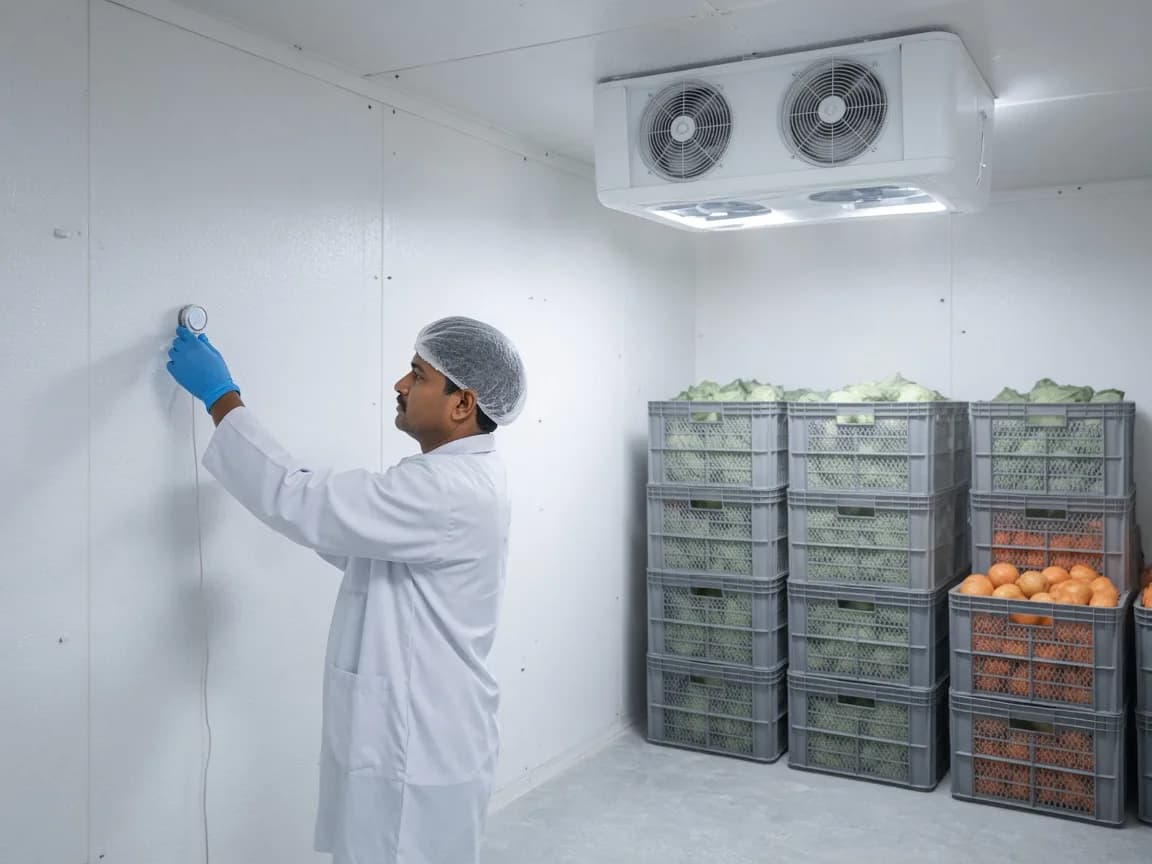
Cold Room Temperature Controls
Temperature control systems can be configured for individual cold rooms according to their specified operating ranges and refrigeration equipment.
Refrigeration Automation and Control
For temperature critical operations
Uniref designs, supplies, installs, and commissions refrigeration automation and control systems for cold storage, industrial refrigeration, and temperature controlled applications across India. The control architecture is developed around the refrigeration plant, operating conditions, equipment configuration, monitoring requirements, and site utilities.
Engineering coordination from Jaipur. Call +91 7222 001 000.
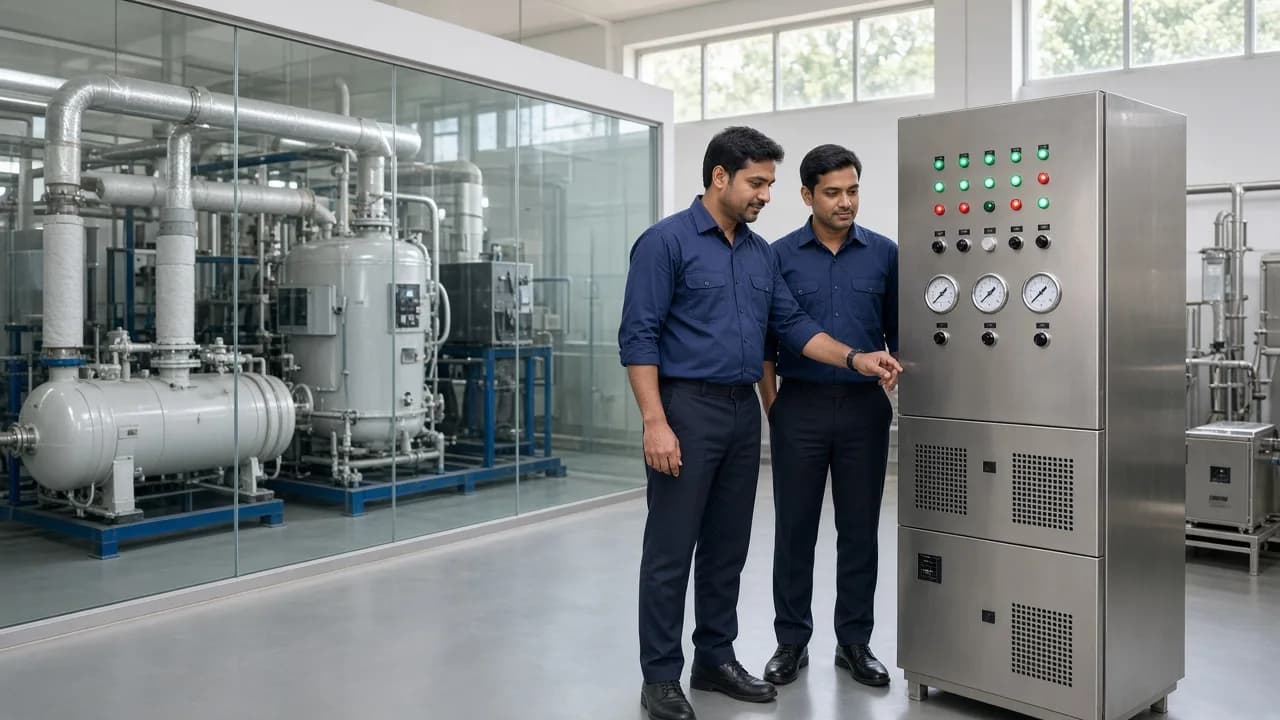
Temperature duty
Ambient
15°C to 25°C
Sensors, sequencing, and alarms, set for the refrigeration plant.
20+ years of experience, 2,500+ projects completed, offices in Jaipur, Chennai, Delhi and Indore, 40+ service locations, 4+ assembly facilities.
20+
Years of experience
2,500+
Projects completed
4
Offices in Jaipur, Chennai, Delhi and Indore
40+
Service locations
4+
Assembly facilities
Applications
Businesses across food, pharmaceutical, hospitality, distribution, and industrial operations can use refrigeration automation to monitor equipment, manage temperature conditions, identify alarms, and coordinate refrigeration operations.
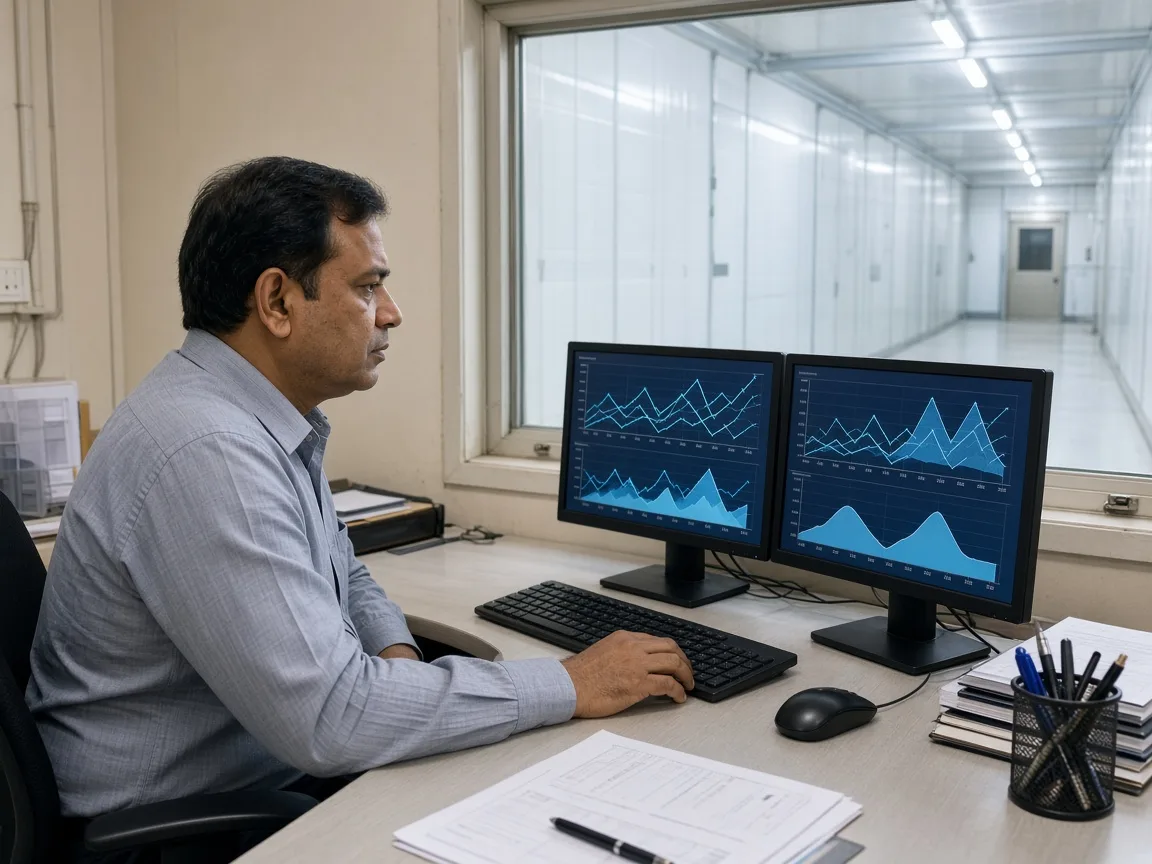
Plant engineering
Refrigeration automation is not only about installing a controller. The control system needs to correspond with the refrigeration equipment, chamber conditions, operating sequence, safety requirements, monitoring needs, and the way the facility is operated.
Uniref develops control arrangements around the actual refrigeration plant and its operating requirements. Sensors, controllers, electrical controls, alarms, monitoring, and selected automation functions are coordinated with the refrigeration equipment.
The control arrangement is developed around the refrigeration equipment, chamber configuration, operating sequence, and site requirements.
Temperature controllers and sensors help maintain the specified operating range for the connected refrigeration application.
Control logic can coordinate selected refrigeration equipment and operating sequences according to the system configuration.
Alarm functions can identify selected temperature, equipment, electrical, or system conditions that require operator attention.
Monitoring can provide visibility into selected temperatures, equipment status, alarms, and operating parameters.
Electrical controls are coordinated with refrigeration equipment, sensors, safety functions, and the required operating sequence.
Remote monitoring can be incorporated when the facility requires access to selected operating information away from the equipment location.
Systems
Different refrigeration plants require different levels of control and monitoring. Uniref develops the automation arrangement according to the equipment, operating conditions, number of controlled areas, monitoring requirements, and site infrastructure.
Temperature control systems can be configured for individual cold rooms according to their specified operating ranges and refrigeration equipment.
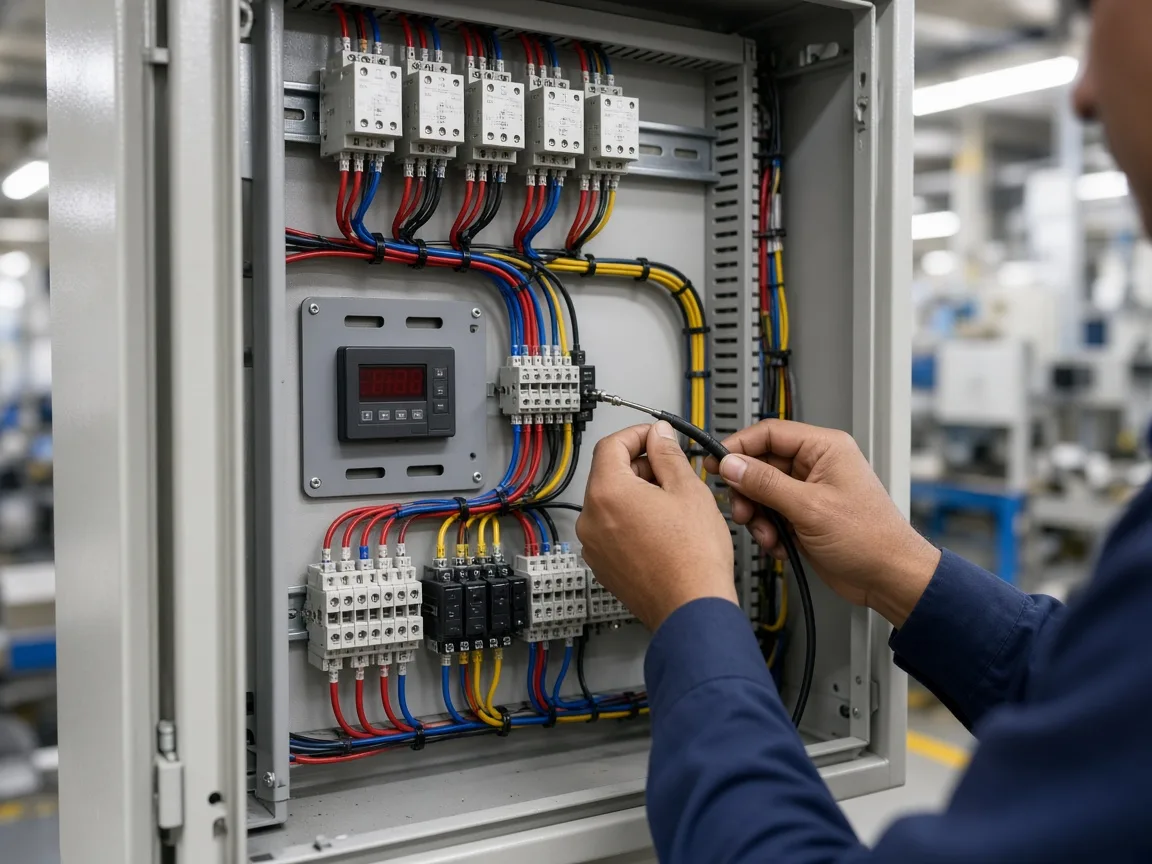
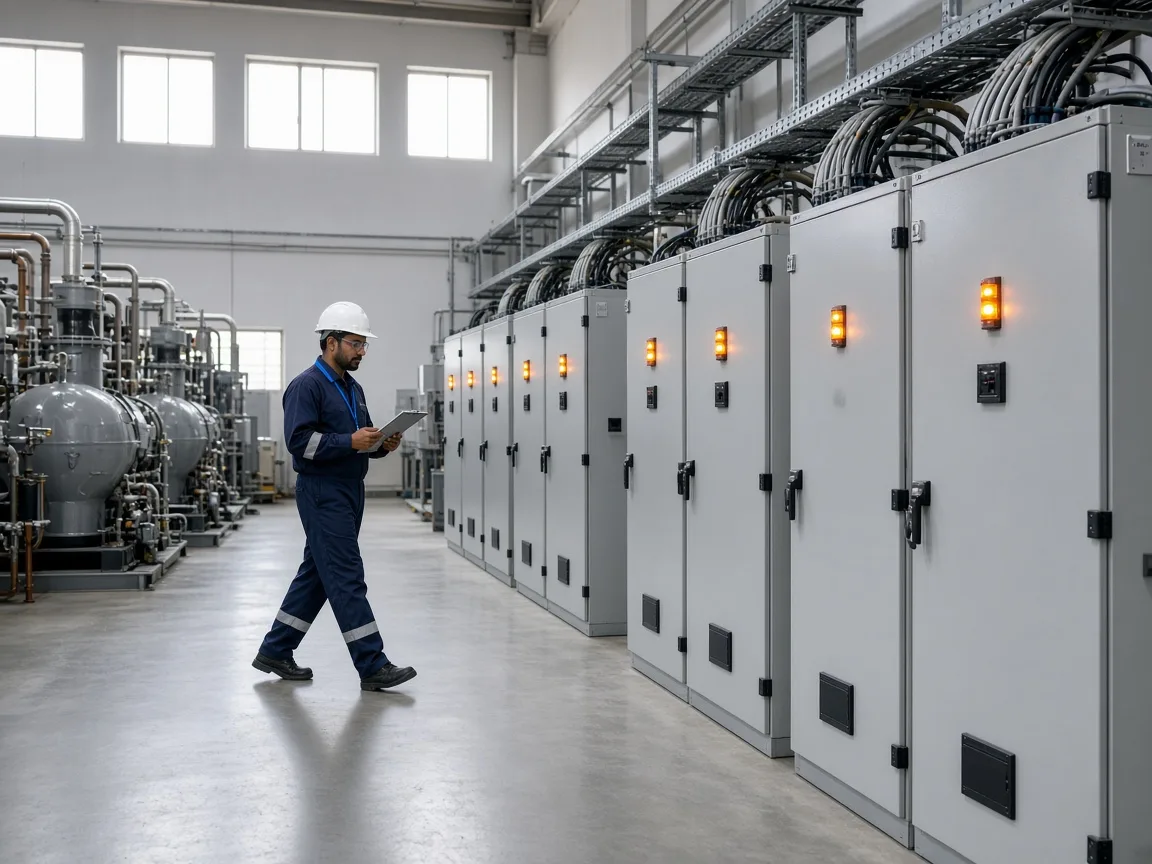
Control panels can coordinate selected refrigeration equipment, sensors, electrical components, alarms, and operating functions.
Compressor control arrangements can be configured according to the refrigeration plant, compressor selection, operating sequence, and system requirements.
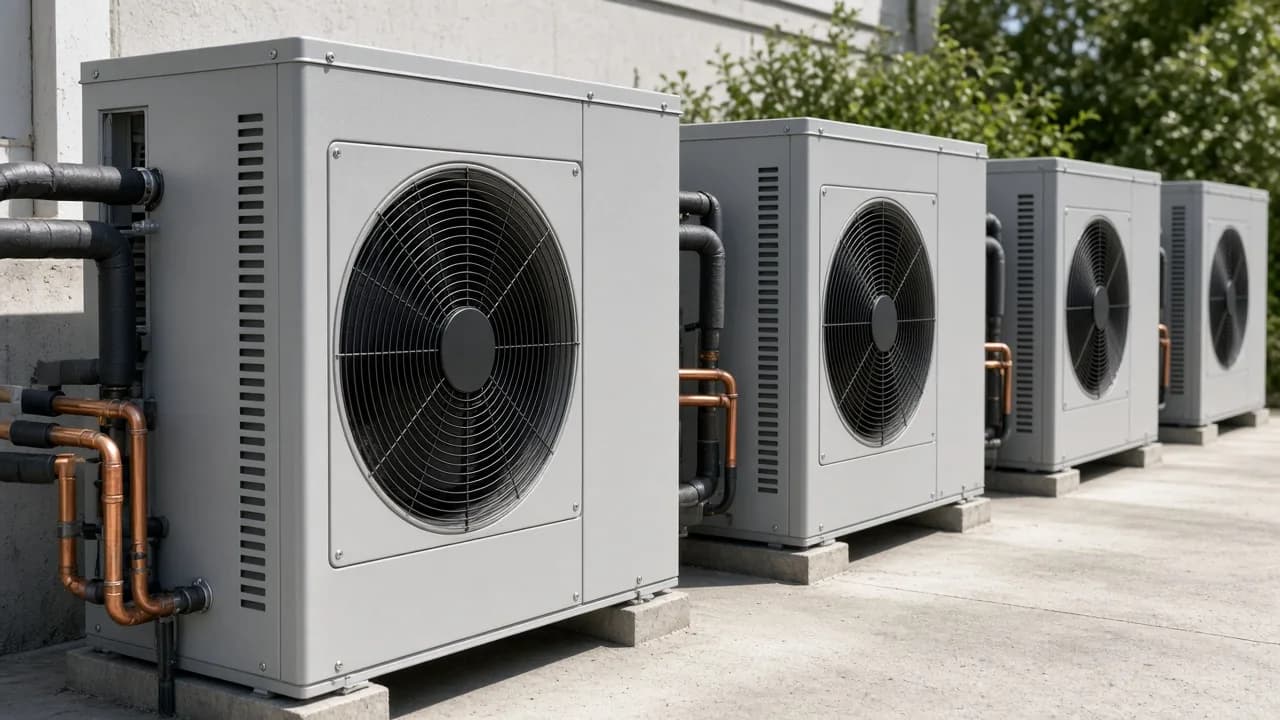
Condensing unit controls can coordinate equipment operation with the refrigeration demand and selected control logic.
Evaporator controls can manage selected functions such as temperature monitoring, fan operation, defrost, and related operating sequences.
Temperature monitoring systems provide visibility into selected room and equipment temperatures and can support alarm functions.
Multiple refrigeration systems or controlled areas can be coordinated through a centralized control arrangement where the project requires it.
Remote monitoring can provide access to selected system information, alarms, and operating parameters according to the required configuration.
Planning a Refrigeration Automation Project?
Share your refrigeration equipment, controlled areas, temperature requirements, monitoring needs, and project location with our engineering team.
Temperature duty
Refrigeration controls are configured according to the required temperature, equipment arrangement, operating sequence, environmental conditions, and monitoring requirements. The final control logic is established from the refrigeration plant and the way the facility needs to operate.
+2°C to +8°C
Applications for medicines, vaccines, dairy, and other temperature sensitive products can use dedicated temperature monitoring and control according to the required operating range.
Actual temperature and humidity requirements depend on the stored product and operational conditions.
Industries
Control requirements vary between industries because product conditions, refrigeration equipment, operating schedules, and monitoring requirements are different.
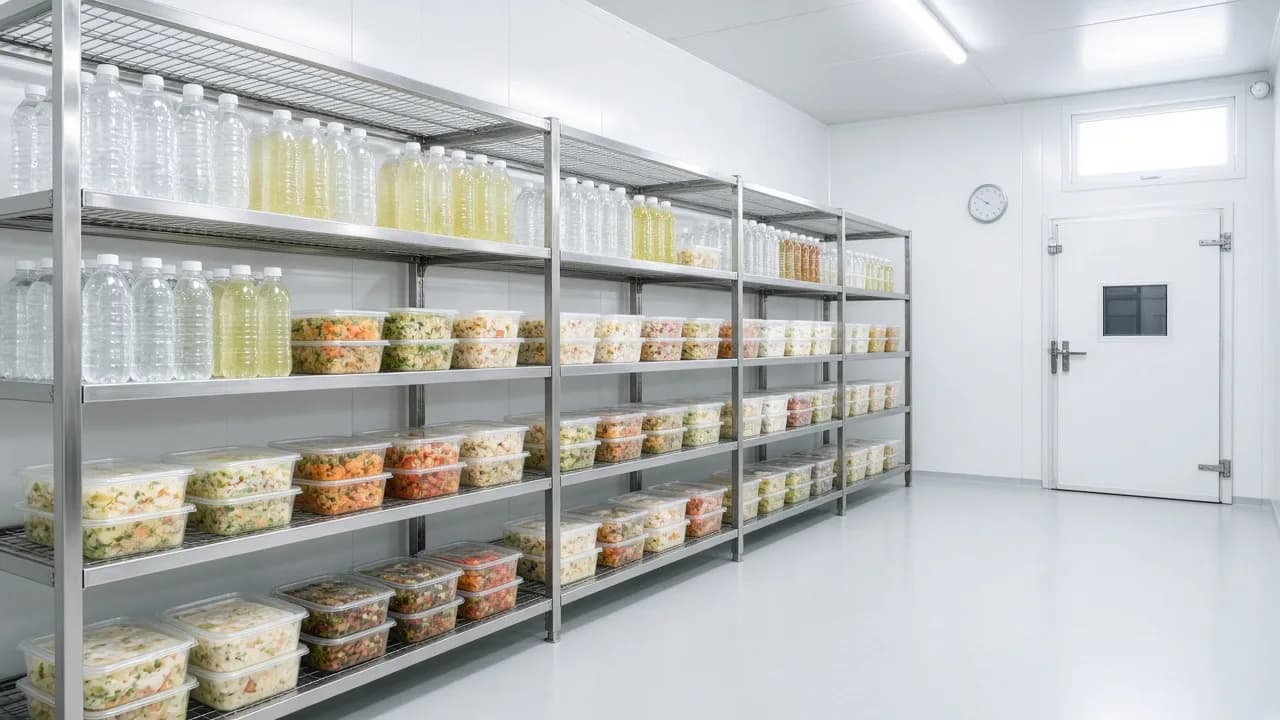
Automation can coordinate temperature control, refrigeration equipment, alarms, monitoring, and selected operating functions across food and beverage facilities.
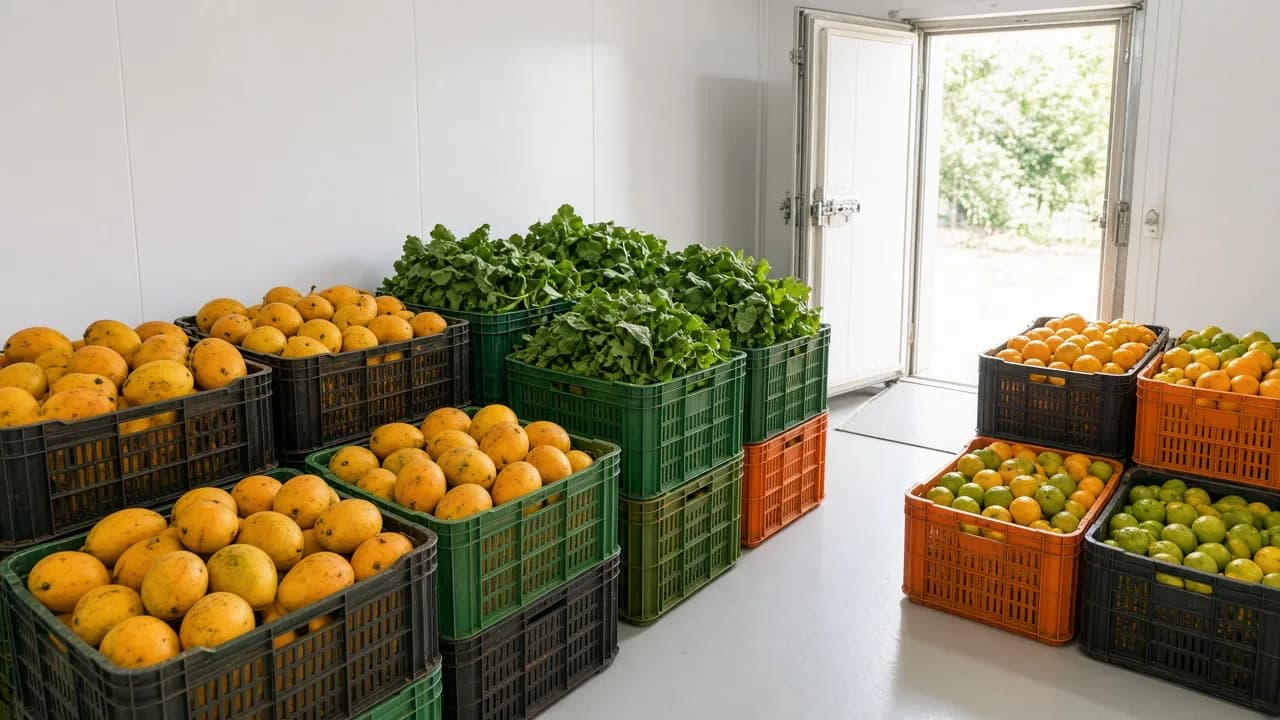
Controls can help maintain specified temperature conditions while providing visibility into room temperatures, equipment status, and alarms.
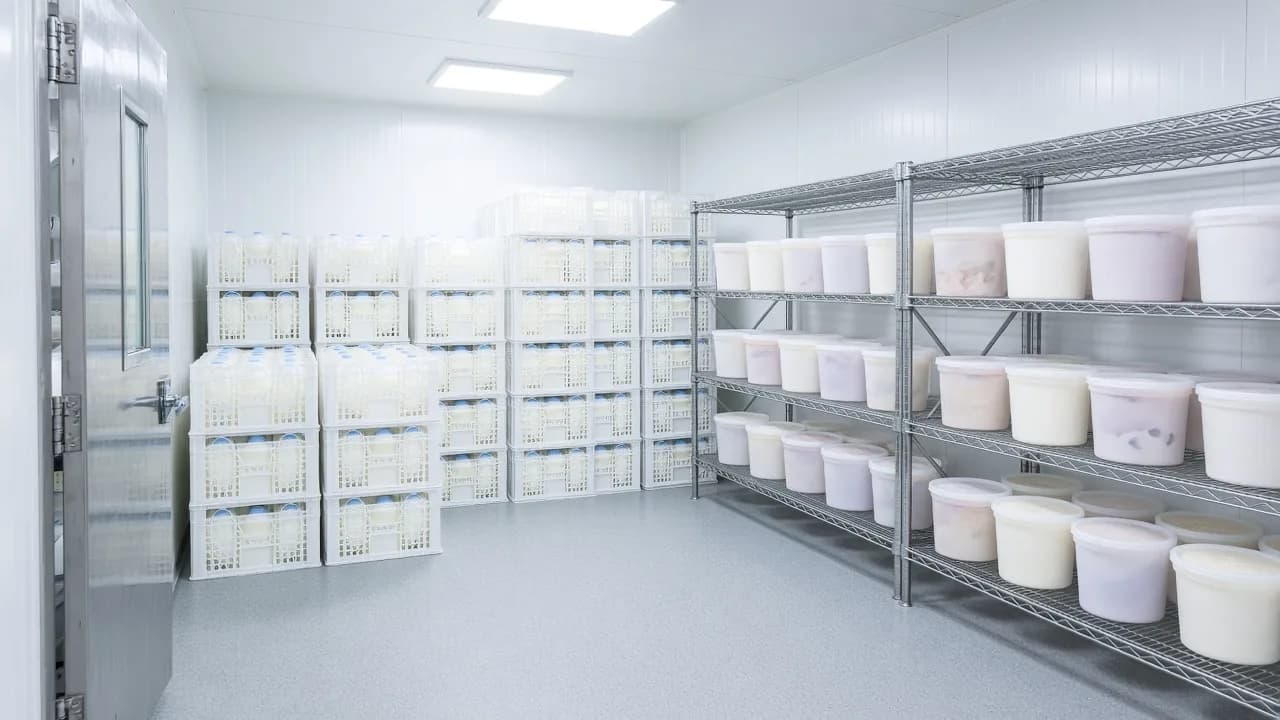
Temperature monitoring and refrigeration controls can support chilled and frozen dairy applications according to their specified operating requirements.
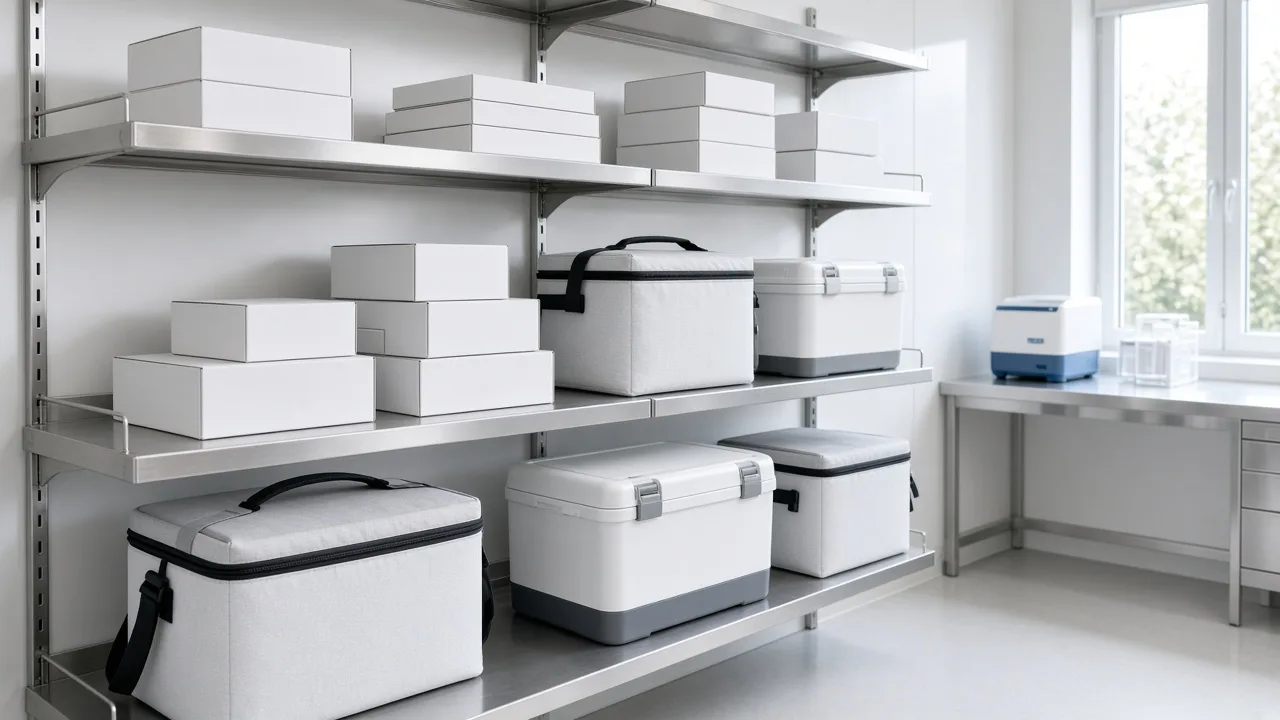
Pharmaceutical and healthcare applications can use dedicated temperature monitoring, alarms, data logging, and control arrangements according to the product requirement.
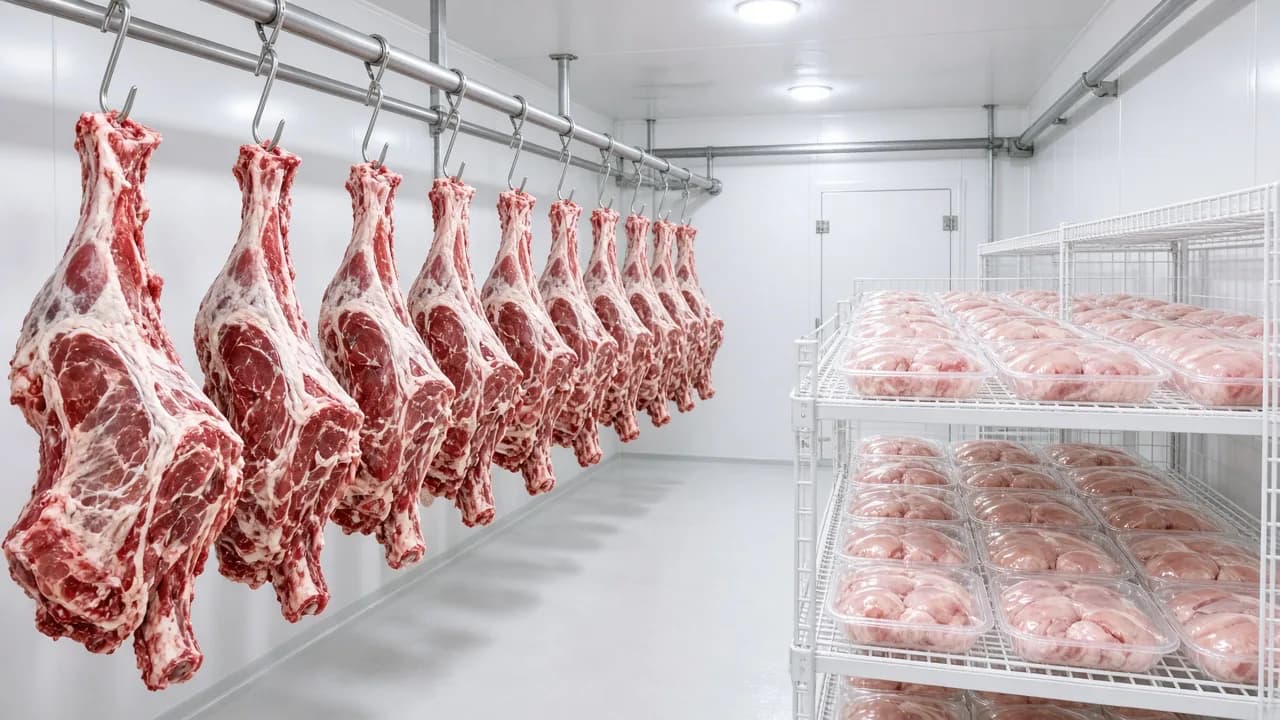
Refrigeration controls can coordinate temperature monitoring and selected equipment functions for chilled and frozen meat and poultry facilities.
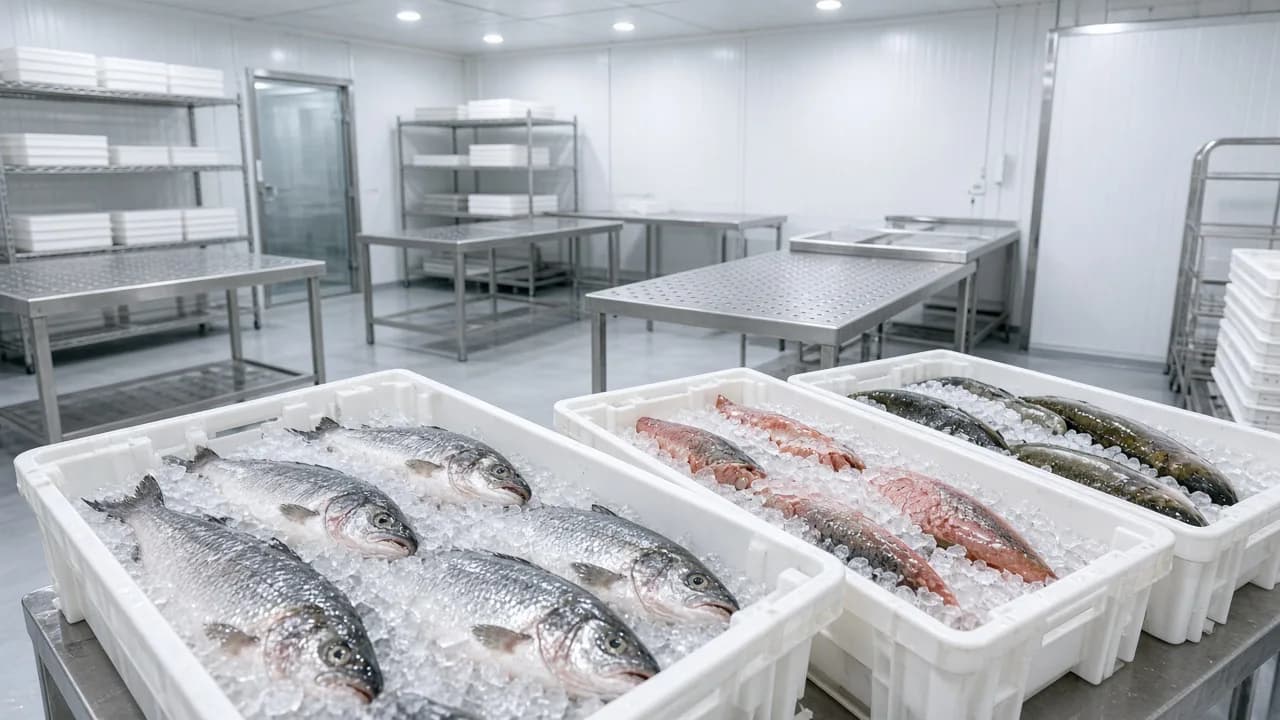
Seafood facilities can use refrigeration automation for temperature monitoring, equipment coordination, alarm management, and selected low temperature applications.
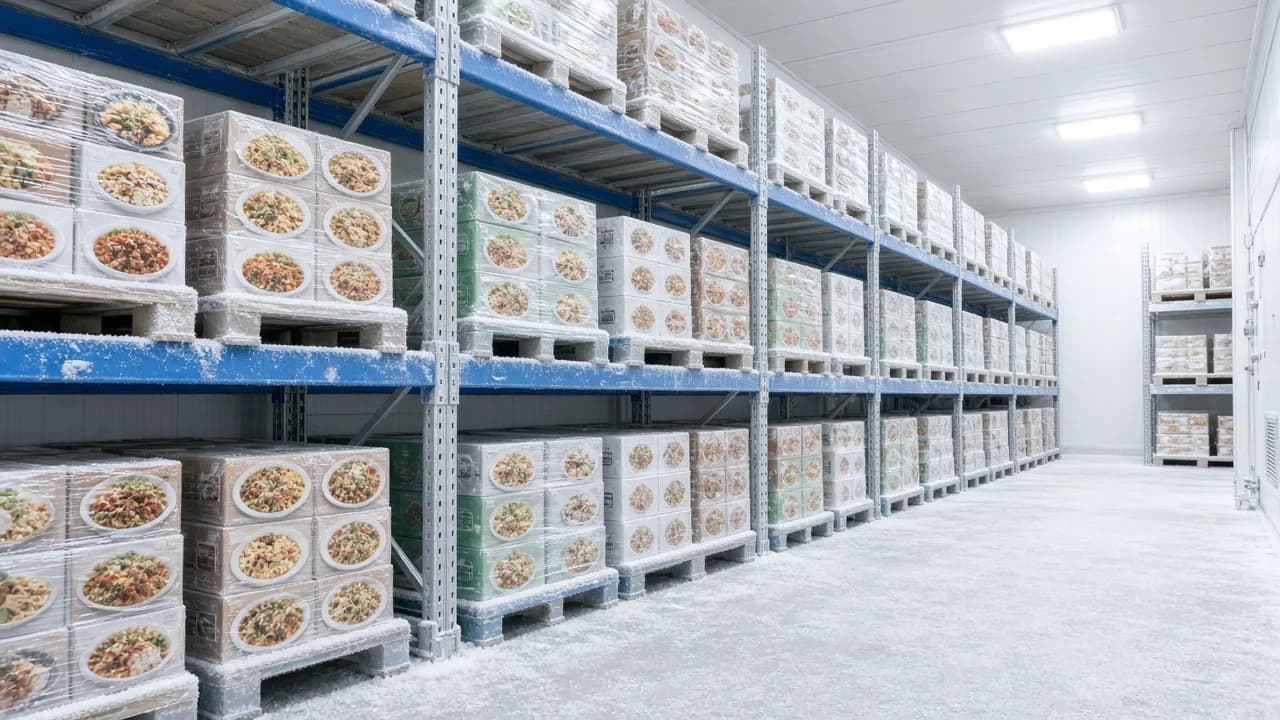
Frozen food facilities can use low temperature refrigeration controls with monitoring, alarms, defrost management, and equipment sequencing where required.
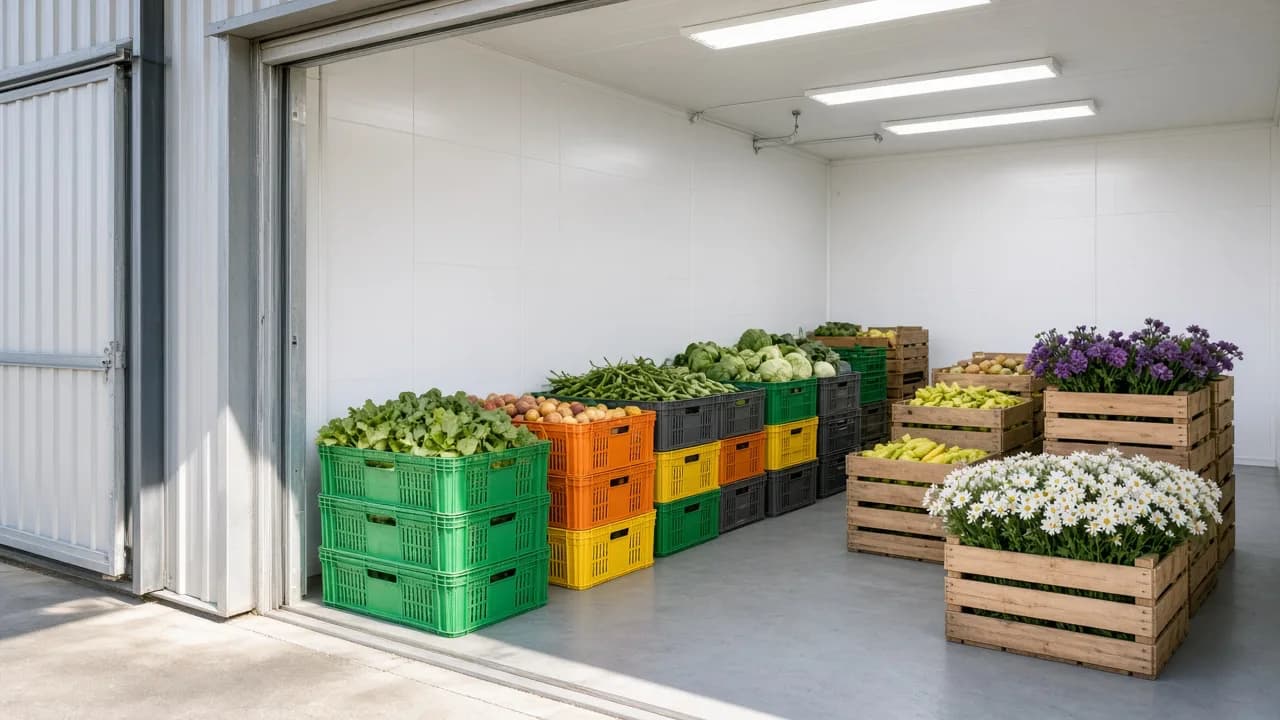
Agricultural and horticultural storage can use temperature and humidity monitoring with refrigeration controls configured around the stored product.
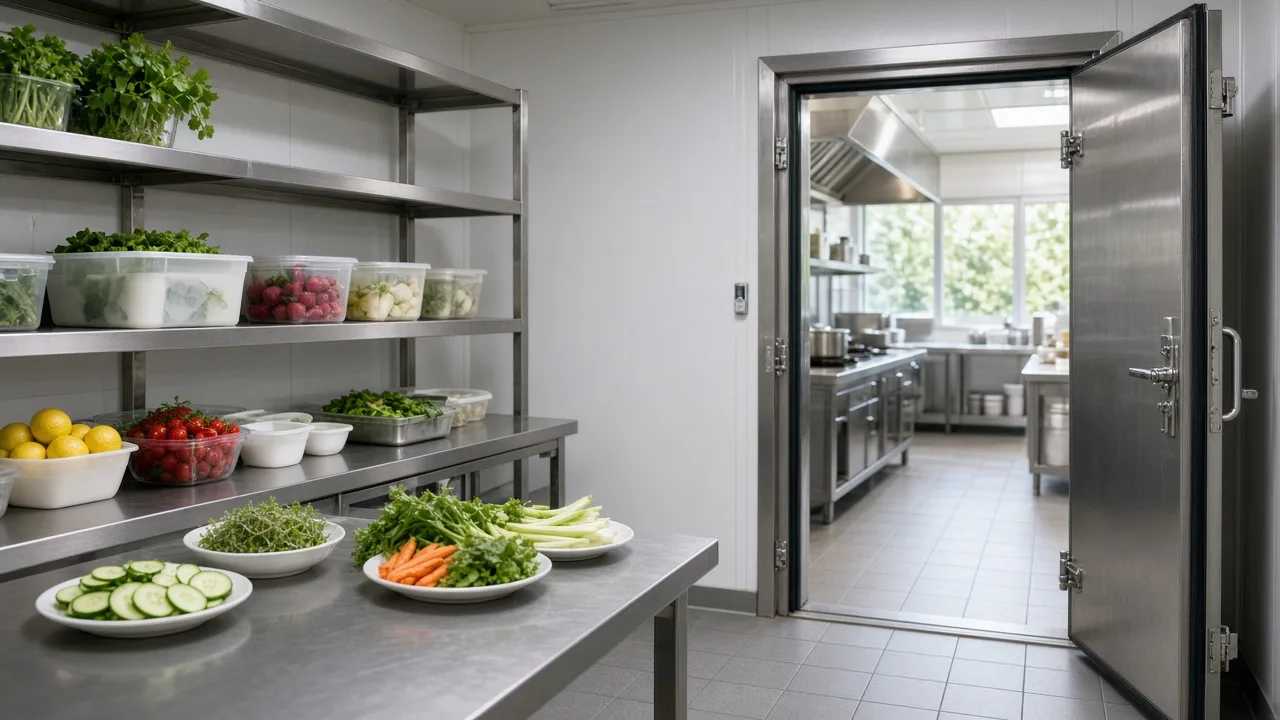
Hotels, commercial kitchens, and food service operations can use refrigeration controls for selected cold rooms, freezers, and temperature controlled storage areas.
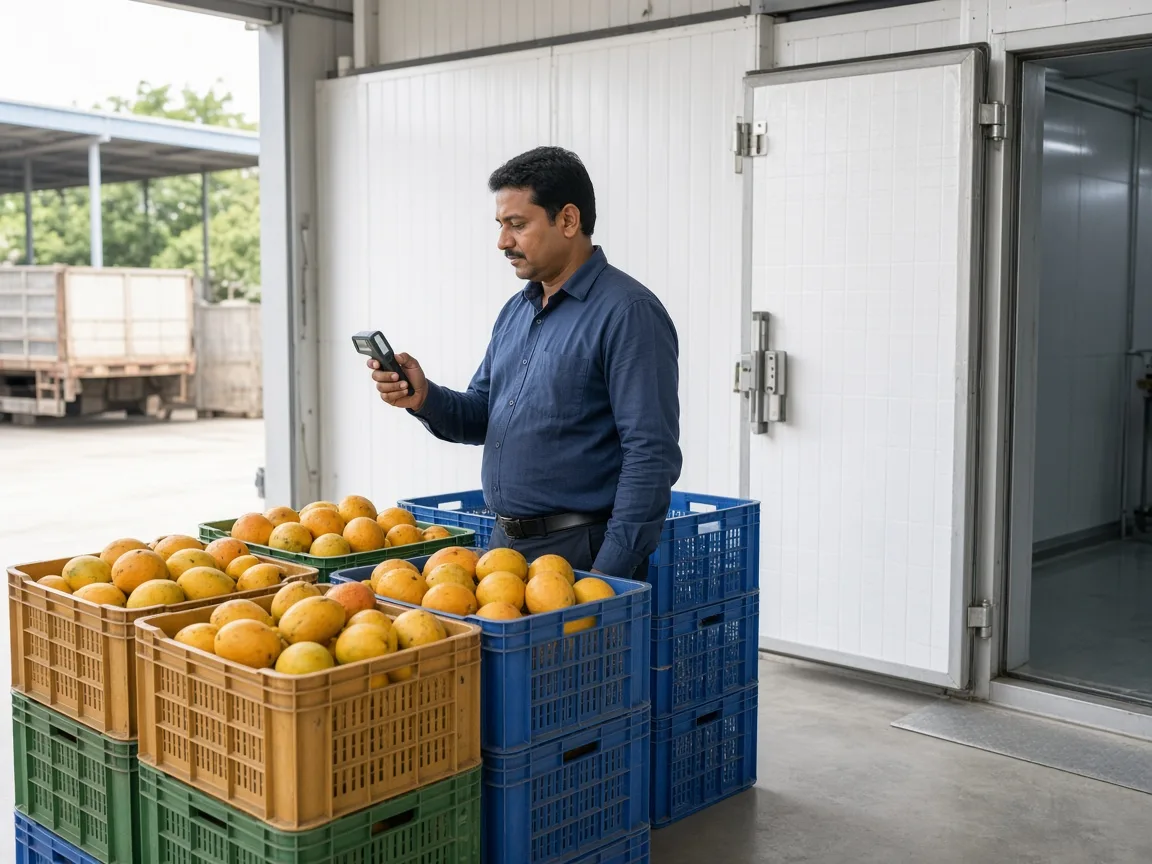
Cold chain facilities can use centralized monitoring and refrigeration automation to maintain visibility across multiple temperature controlled areas and equipment.
Inside the controlled area
The automation system, electrical controls, sensors, refrigeration equipment, alarms, and monitoring functions are designed as one coordinated system. Each component is selected according to the refrigeration plant, operating conditions, required control logic, and site requirements.
Temperature sensors measure room or process conditions and provide inputs to the selected control system.
Humidity sensors can be included where relative humidity is an important operating parameter for the stored product or process.
Evaporator control functions can coordinate selected fan, defrost, temperature, and operating sequences.
Room controllers can manage the specified operating conditions for individual cold rooms or controlled areas.
Alarm functions can identify selected temperature, equipment, electrical, or system conditions that require attention.
Outside the controlled area
Panels, programmable controllers, and equipment controls sit with the refrigeration plant and are selected after the operating sequence and site utilities are known.
Control panels house selected electrical and automation components required to operate and monitor the refrigeration system.
PLC based control can be used where the refrigeration plant requires programmable sequencing and coordinated equipment operation.
Compressor controls can coordinate compressor operation according to refrigeration demand and the configured operating sequence.
Condensing unit controls can manage selected equipment functions according to the refrigeration system design.
Monitoring and communication
Monitoring brings selected temperatures, logs, remote access, and centralized views together for the rooms and equipment on that project.
Monitoring systems can display selected temperature values from connected rooms and equipment.
Data logging can record selected operating parameters for review and operational reference.
Remote access can be configured where the facility requires visibility into selected system conditions away from the plant.
Multiple controlled areas and selected refrigeration equipment can be brought into one monitoring interface according to the project requirement.
Refrigeration controls
The control system is selected after the refrigeration equipment, heat load, operating temperatures, site utilities, equipment sequence, and monitoring requirements are assessed. The automation architecture is configured around the actual plant rather than applying one control arrangement to every refrigeration application.
Compressor operation can be coordinated according to refrigeration demand, operating pressure, temperature conditions, and the selected system configuration.
Condensing unit controls can coordinate selected equipment functions according to the refrigeration plant design and operating requirements.
Evaporator fan operation can be controlled according to room conditions, temperature requirements, defrost sequences, and the selected operating logic.
Defrost functions can be configured according to evaporator conditions, operating temperature, moisture load, and refrigeration system requirements.
Temperature control uses selected sensors and controllers to maintain the specified operating range for each connected room or process.
Where humidity is an important operating parameter, suitable sensors and control functions can be incorporated according to the application.
Pressure related monitoring can be incorporated where required by the refrigeration system and equipment configuration.
Alarm logic can identify selected temperature, pressure, equipment, electrical, and system conditions that require operator attention.
Automation can be developed for industrial refrigeration where multiple refrigeration systems, equipment groups, or controlled areas need coordinated operation.
Project delivery
Refrigeration automation and control projects require coordination between the refrigeration plant, electrical system, sensors, control logic, monitoring interface, and operating team. Uniref can manage the control scope from requirement assessment through installation, testing, commissioning, and handover.
The refrigeration equipment, controlled areas, temperature requirements, operating sequence, monitoring needs, alarms, and user requirements are reviewed.
The existing refrigeration plant, electrical infrastructure, control panels, sensors, communication requirements, and available installation space are assessed.
The required control structure is developed around the refrigeration equipment, controlled areas, automation functions, safety requirements, and monitoring requirements.
Controllers, sensors, control panels, electrical components, monitoring equipment, and communication devices are selected according to the project requirements.
Control panels are developed around the selected equipment, electrical requirements, control logic, safety functions, and installation conditions.
Control logic, operating sequences, alarm conditions, temperature settings, and selected automation functions are configured according to the approved requirements.
Control panels, sensors, electrical connections, communication systems, monitoring equipment, and associated components are installed at the site.
Inputs, outputs, sensors, alarms, equipment sequences, control functions, and monitoring interfaces are tested during commissioning.
The operating team is guided on the control interface, alarms, monitoring functions, operating procedures, and relevant system requirements.
Support can include troubleshooting, preventive maintenance, control system inspection, sensor replacement, programming adjustments, and selected upgrades.
This approach can also be incorporated into turnkey cold storage solutions where refrigeration automation forms part of a complete cold storage project.
Project inputs
A control system should reflect how the refrigeration plant actually operates. Uniref reviews the refrigeration equipment, controlled rooms, temperature requirements, site utilities, operating sequence, and monitoring expectations before defining the automation architecture.
What refrigeration equipment is installed?
The compressor, condensing unit, evaporator, valves, sensors, and associated equipment determine the control inputs and outputs required.
What temperature range is required?
The required operating range determines temperature sensors, controllers, alarms, and selected control logic.
How many rooms or zones are controlled?
The number of rooms and temperature zones influences the control architecture, monitoring interface, sensors, and panel configuration.
What is the operating sequence?
The required equipment sequence determines how compressors, evaporators, defrost, fans, alarms, and other functions are coordinated.
What utilities are available?
Electrical supply and other site utilities affect control panel design, equipment selection, and installation requirements.
What is the existing control system?
Existing controllers, panels, sensors, and monitoring systems are reviewed where automation is being upgraded or integrated.
Where will the control panels be installed?
Panel location affects cable routing, environmental conditions, accessibility, installation, and maintenance requirements.
How will operators use the system?
The control interface and monitoring arrangement should reflect the information operators need during normal operation and alarm conditions.
What parameters need to be monitored?
Temperature, humidity, pressure, equipment status, alarms, and other selected parameters are identified according to the refrigeration application.
What alarms are required?
Alarm conditions are defined from the operating range, equipment protection requirements, and facility operating procedures.
Is remote monitoring required?
Remote access can be considered when the operation requires visibility into selected refrigeration conditions away from the control panel.
Control efficiency
A well configured automation system coordinates refrigeration equipment according to actual operating demand and defined control conditions. The objective is to provide appropriate control, monitoring, equipment sequencing, and alarm visibility without adding unnecessary functions.
Sensors are positioned according to the room layout, airflow, product arrangement, and parameter being measured.
Temperature control is configured around the specified operating range and the characteristics of the connected refrigeration system.
Where multiple compressors are used, control logic can coordinate operation according to the refrigeration demand and selected sequence.
Defrost functions are configured according to evaporator conditions and the operating requirements of the refrigeration system.
Evaporator fan operation can be coordinated with temperature control, defrost, and selected operating sequences.
Control logic can be configured to operate selected equipment according to defined conditions rather than relying on continuous operation where the system design permits otherwise.
Automated alarms provide visibility when selected temperature, equipment, electrical, or system conditions move outside defined limits.
Multiple rooms and selected equipment can be brought into a centralized monitoring arrangement where the facility requires consolidated visibility.
Selected operating data can be recorded to support operational review and identification of abnormal conditions.
Control settings, sensors, alarms, and operating sequences can be reviewed during maintenance to identify requirements for adjustment or improvement.
Quality and safety
Uniref has quality documentation on file for cold rooms, heat exchangers, condensing units, and their parts, including ISO 9001:2015, certificate QMS/23M0934, GMP, certificate GMP/23M0935, and CE compliance with the Machinery Directive 2006/42/EC, certificate CE/23M0936. These documents were first registered on 7 April 2023, with recertification due on 6 April 2026. Ask the Uniref team for the current documents applicable to your project.
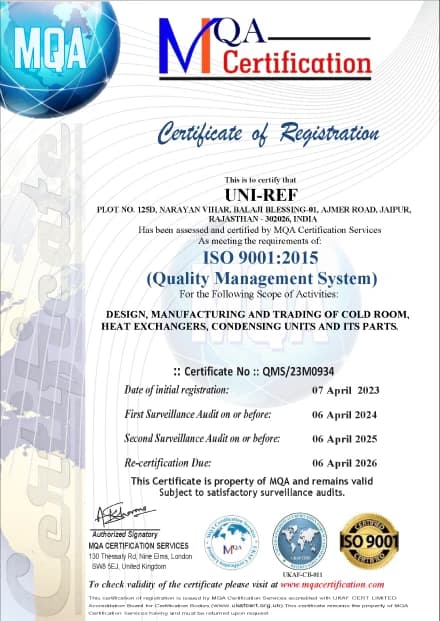
Quality management system. Certificate QMS/23M0934. Scope: design, manufacturing and trading of cold rooms, heat exchangers, condensing units and their parts.
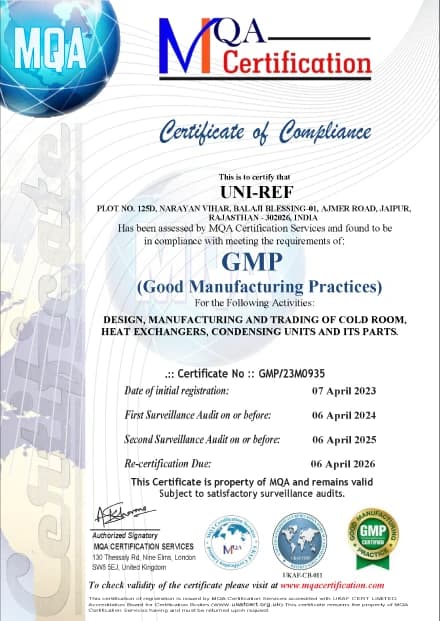
Good manufacturing practices. Certificate GMP/23M0935. Same product scope as the quality system certificate.
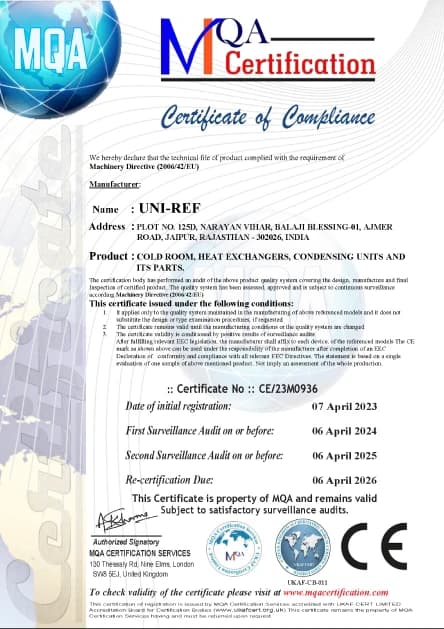
Certificate of compliance CE/23M0936 with the Machinery Directive 2006/42/EC for cold rooms, heat exchangers, condensing units and their parts.
Electrical control panels, wiring, protection devices, and associated components are selected and installed according to the refrigeration plant and project requirements.
Controllers, sensors, electrical components, and monitoring equipment are selected according to the operating conditions and required control functions.
Selected automation and refrigeration components are assessed according to the system requirements before being incorporated into the project.
Control logic can include selected safety functions, equipment interlocks, alarms, and operating limits according to the refrigeration system.
Where automation is connected to food, pharmaceutical, or other temperature sensitive storage, the control arrangement is coordinated with the operating and hygiene requirements of the facility.
Alarm and protection functions can identify selected abnormal conditions and provide operators with information needed for corrective action.
After sales
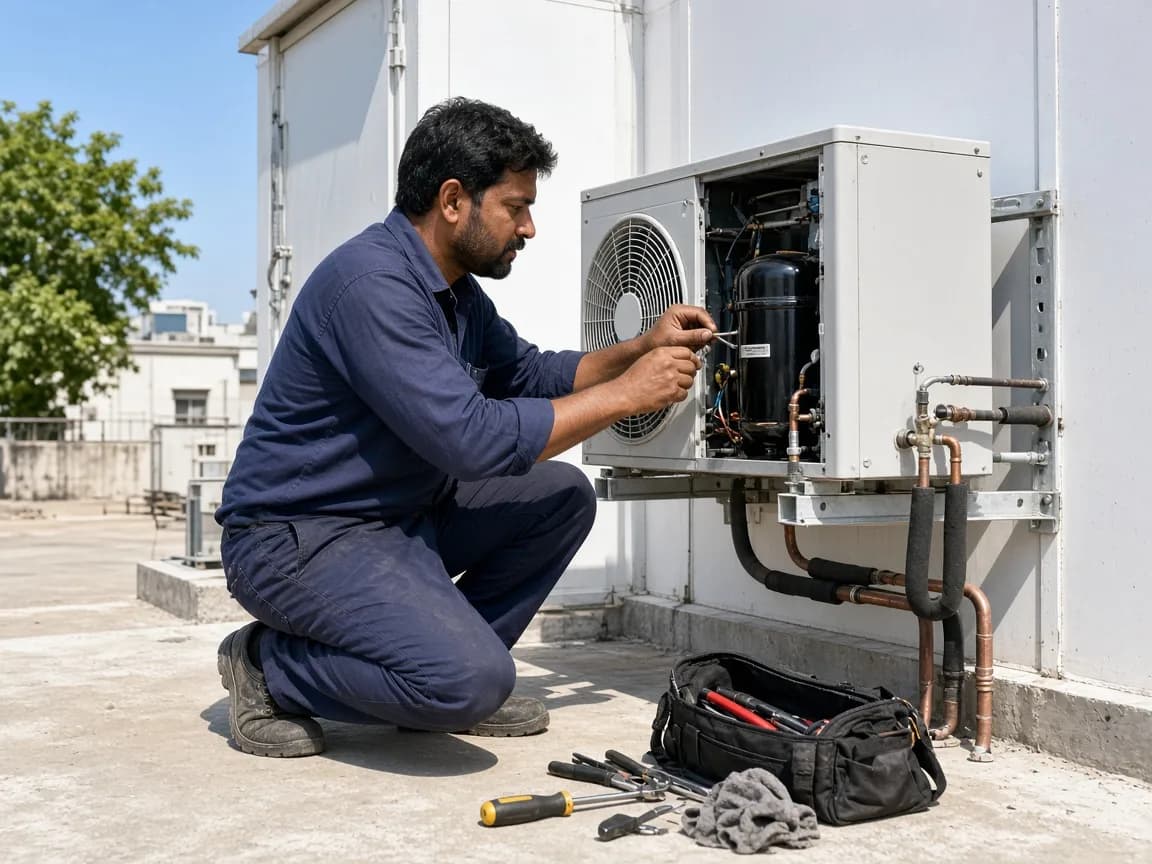
Automation systems require periodic inspection, sensor checks, troubleshooting, and configuration review as the refrigeration plant operates. Uniref provides post installation support according to the installed system and the facility's operational requirements.
Control panels, sensors, electrical connections, monitoring interfaces, and selected automation functions can be inspected as part of planned maintenance.
Annual maintenance arrangements can be considered according to the installed control system, refrigeration equipment, facility requirements, and selected service scope.
Control faults, sensor issues, communication problems, and selected equipment control issues can be assessed for corrective action.
Replacement controllers, sensors, electrical components, communication devices, and other required parts can be assessed according to the installed system.
Periodic inspection can review sensors, control panels, wiring, alarms, monitoring functions, equipment signals, and operating sequences.
Control settings, operating sequences, alarms, and selected automation functions can be reviewed when system adjustments are required.
Control related refrigeration faults can be inspected and addressed according to the installed equipment and identified problem.
Existing refrigeration controls can be assessed for selected automation upgrades, monitoring improvements, sensor replacement, or control system changes.
FAQ
Refrigeration automation and control refers to the systems used to monitor and coordinate refrigeration equipment, temperatures, alarms, sensors, electrical functions, and selected operating sequences. Depending on the application, this can include temperature controllers, PLC systems, sensors, control panels, monitoring interfaces, data logging, and remote monitoring. The actual arrangement depends on the refrigeration equipment, controlled areas, operating conditions, site utilities, and the level of automation required.
Project enquiry
Share your refrigeration equipment, required temperature ranges, number of controlled rooms, existing control system, monitoring requirements, and project location so our engineering team can understand the application.
Name and phone are required. Other project details can be shared through the form.